27 April 2023
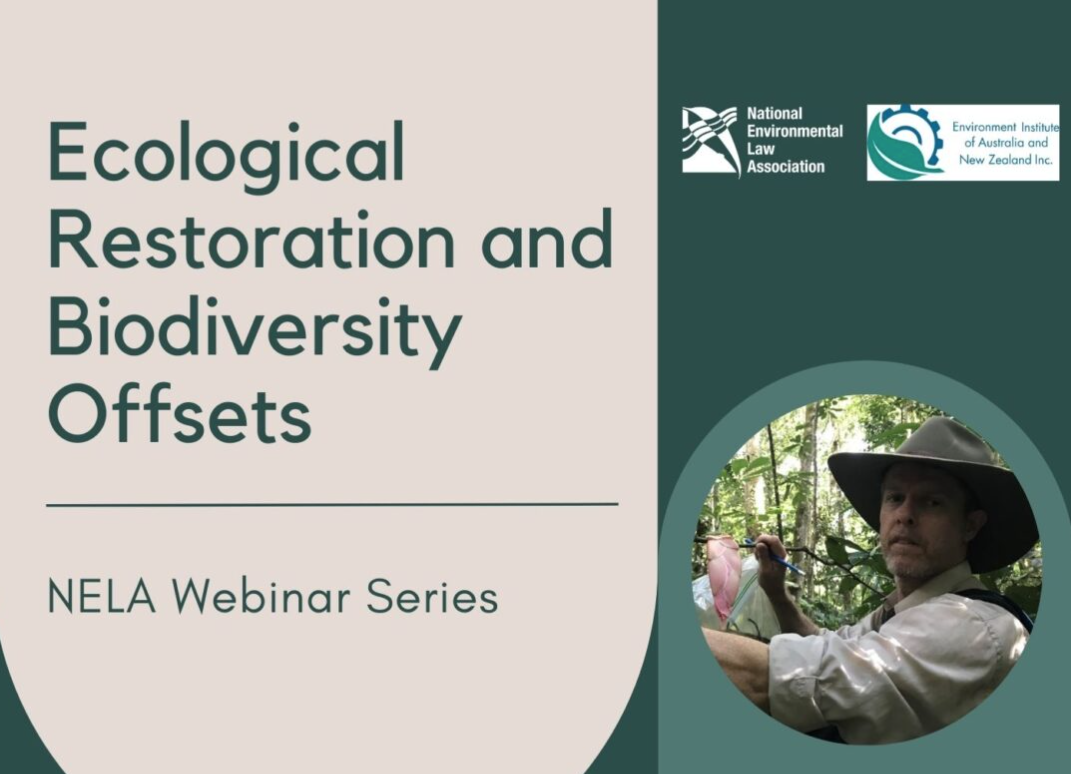
Ecological Restoration and Biodiversity Offsets
While actions to protect the environment and mitigate threatening processes like climate change remain critical, the second half of environmental law’s first century has seen a shift in focus to restoration. The years spanning 2021-2030 have been declared the ‘Decade on Ecosystem Restoration’ by the United Nations, with the aim of ‘supporting and scaling up efforts to prevent, halt and reverse the degradation of ecosystems worldwide’.
Restoration is especially urgent in Australia’s coastal regions. It is now well known that coastal wetlands deliver crucial ecosystem services like water filtration, carbon sequestration, fisheries habitat and shoreline protection. Unfortunately though these marine ecosystems have been historically undervalued, with 50% of global coastal wetland extent lost during the 20th century. Wetlands continue to be threatened by activities and phenomena including fishing, aquaculture, clearing and development, pollution and climate change.
In January 2022, the Federal Government released a methodology for blue carbon projects under Australia’s Emissions Reduction Fund. This allows for some restoration projects, namely, tidal restoration of blue carbon ecosystems, to be accredited and receive carbon credits. Since then, interest in coastal restoration has increased significantly, with developments like NSW’s Blue Carbon Strategy 2022-227. There is a distinct sense that we have reached a tipping point in the coastal restoration space in Australia, and the Blue Carbon methodology may be the start of a groundswell of progress and large-scale implementation of projects.
But with this potential comes a great risk; in the absence of an overarching strategy for coastal restoration, projects will be chosen based on unclear criteria and the opportunity to achieve connected environmental outcomes across the landscape may be lost. It is crucial that there is an enabling legal framework in place to guide considered and coordinated selection of project sites to ensure the best possible environmental outcomes are achieved. Justine’s presentation will consider how this can be achieved, incorporating lessons from the protection and management realm.
Ecological restoration is often a conditioned requirement of development approvals, is necessary to deliver biodiversity offsets and is integral to the Commonwealth’s Nature Positive Plan. David will provide an overview of the practice of ecological restoration, use ‘hands on’ examples to illustrate different ecological restoration approaches and discuss its place in biodiversity offset delivery.
About EIANZ
The Environment Institute of Australia and New Zealand is a not for profit, professional association that supports environmental practitioners at all stages of their career. The Institute’s key programs include the Certified Environmental Practitioner Scheme scheme and the Australasian Journal of Environmental Management.
About the Speakers
David Francis
David is an ecologist with over 30 years’ experience in flora and fauna studies, vegetation mapping, ecological assessments, ecological restoration plans and strategic environmental planning.
He has undertaken ecological surveys spanning the Wet Tropics to Victoria, and abroad to Papua New Guinea. David has delivered multiple ecological restoration projects and was a lead author of the SEQ Ecological Restoration Framework which is endorsed by the SEQ Council of Mayors as the regional standard for ecological restoration. He was convenor of the EIANZ’s National Biodiversity Offset conferences in 2019 and 2022.
Justine Bell-James
Justine Bell-James is an Associate Professor at the TC Beirne School of Law with expertise in environmental and climate change law and climate change litigation. She holds a PhD from QUT (2010) and was a postdoctoral research fellow at UQ’s Global Change Institute from 2011-2013. Justine’s research focuses on legal mechanisms for protection of the coast under climate change, incorporating both human settlements and coastal ecosystems. She currently leads an ARC Discovery Project (2019-2022) considering how coastal wetland ecosystem services can be integrated into legal frameworks. Justine is also an expert on legal mechanisms to facilitate blue carbon projects in Australia and internationally, and she was involved with the development of a blue carbon methodology under Australia’s Emissions Reduction Fund. Justine’s work is highly interdisciplinary and she is an affiliated researcher with UQ’s Centre for Biodiversity and Conservation Science. Her recent collaborations and consultancies have involved colleagues from science, industry, NGOs, government and legal practice.
Justine also has expertise in climate change litigation, and her work on opportunities for litigation under Queensland’s Human Rights Act 2019 has underpinned the first test case in this area.